
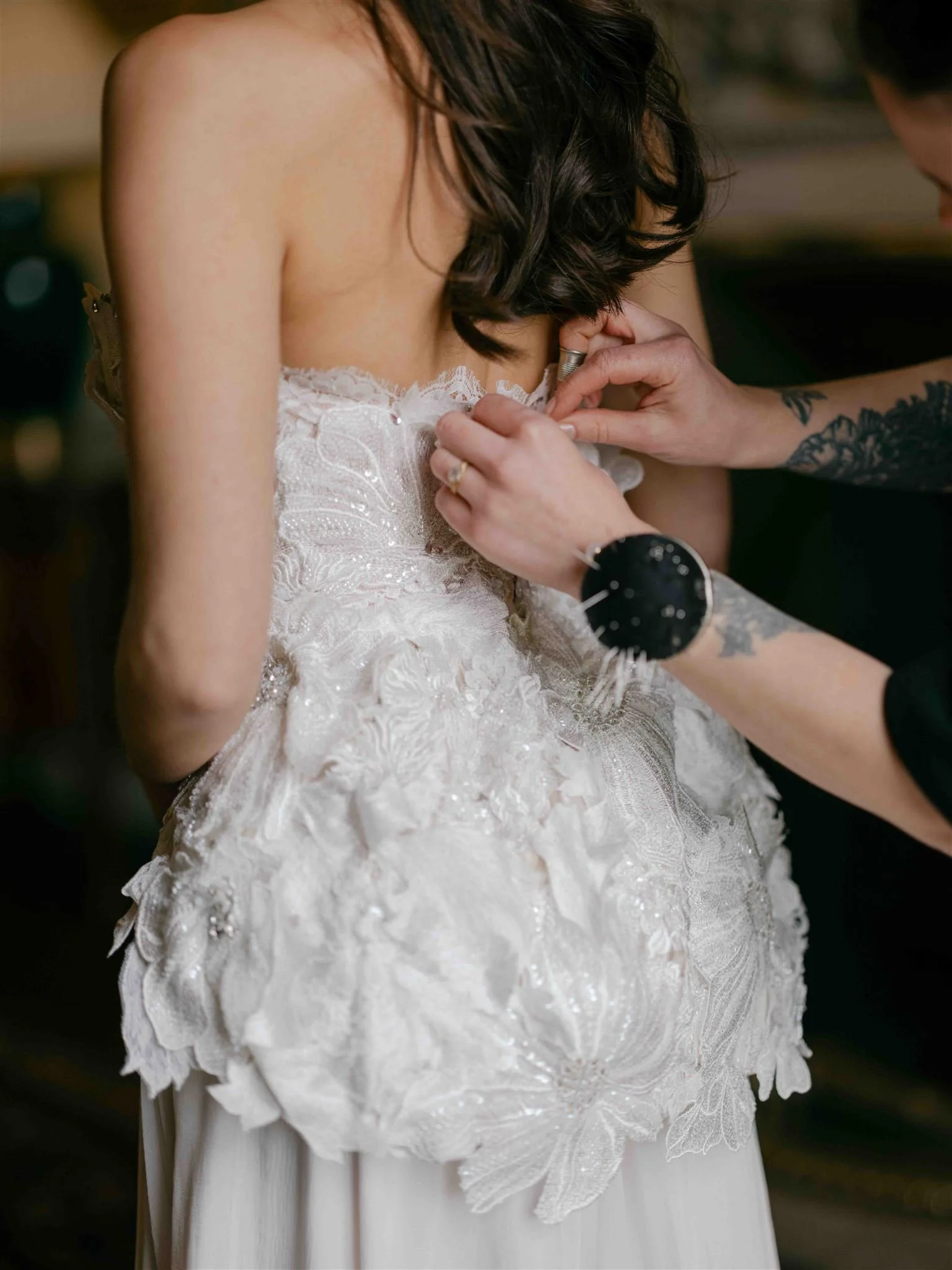
It can be intimidating coming to talk to a bridal designer like me about your wedding dress ideas. However, I always say to brides who come to see me for a bespoke bridal design consultation - and who apologise for not knowing the right terminology, that it doesn’t matter and not to feel silly.
One designer to the next may have different words for things.
Here’s a starter set for some techniques that will help you when your designer is talking to you about some of the elements of the dress and the design and make process.
Construction
Atelier - the workroom.
Garment - a piece of clothing.
Silhouette - the outer shape and contour of the dress if it were to be seen in shadow.
Corset/Corselette - A tight fitting bodice stiffened with boning and pulled tight with lacing strings, used to shape and cinch the waist is a severe way.
Boned Bodice - has the same strength, structure and boning as a corset, but gives a more modern shape and is more comfortable to wear for a long duration.
Godet - a fabric piece inserted into a seam to give more flare, volume and swish. The shape will be a circular sector and could be a slim triangle shape, quarter circle, half-circle or even a full circle and anything in-between.
Gusset - a diamond-shaped fabric insert under the arm to allow a wider range of movement.
Circle skirt - a skirt made from a circle of fabric, with an opening in the centre for the waist. A circle skirt can be made with 1/2 a circle for less volume, or many circles joined together for lots of volume. Generally, this is a skirt that looks great on everybody.
Split - or slit - a vertical opening in the skirt, front, side or back, allowing ease of movement and a glimpse of the legs.
Grain - The grain refers to the warp and the weft of the fabric, up and down and cross-ways.
Straight-grain - when a dress is cut with the warp of the fabric falling down the length of the body.
Bias cut - when the warp and the weft run at a diagonal to the length of the body, bias cut gowns are generally slinky, softly draped dresses and more closely fitted to the body.
Toile - is a prototype version of the dress in a cotton fabric so that the design can be tested, fitted and perfected. Also called a Mock-up, Maquette or a Calico - can refer to the photo-type dress as above, but I will refer to Calico as the cotton fabric the porto-type is made from and it’s a stable and in-expensive fabric.
Raw edge - a cut edge of the fabric which is not finished or bound by stitching and can fray. Raw edges can be decorative - purposely frayed and used on the neckline, frill, or hem. Raw edges on seams will be on the inside of a dress and protected by linings.
Drape - is how the fabric hangs on the body. When talking about drape in dress-making is usually refers to fabric that is positioned and pinned around the body without cutting, creating folds that create structure in an artistic way.
Seam - where two pieces of fabrics are stitched together. and the seam allowance is opened out and pressed with an iron to form a smooth surface.
Seam allowance - the extra fabric around the edge of the fabric pieces to allow for stitching together.
French Seam - a technique which encloses the seam allowance so that raw edges are not visible. This works best on light-weight fabrics.
Dart - a method for shaping garments to the body, mostly seen at the waist and the bust. Generally a triangular shape of fabric tucked to the inside of the garment. This will be seen as a stitch line on the outside of the garment.
Princess seam - A vertical seam line which gives shape to a garment in place of darts.
Hem - the bottom edge of the dress or garment.
Lining - a lightweight fabric (usually satin) stitched inside the dress to hide the seams and make the garment more comfortable to wear.
Overlay - the top layer of fabric - most specifically when different to the fabric underneath.
Yardage - the amount of fabric required to make the dress.
Appliquè - stitching around the edge of a decorative piece of fabric - for Wilden London most often lace, embroidery or beaded motif.
Motif - a piece of embroidery or beadwork made separately to the dress and stitched to the dress fabric by appliquè.
Embellishment - decorative items added to the dress which could include beads, jewels, sequins, ornamental stitching and more.
Embroidery - decorative needlework using threads and beads.
Trimmings - the decorative items added to a dress - ribbons, buttons, beads.
Trim - most often a decorative ribbon applied to a neckline, cuff or hem, or as a decorative motif.
Pleats - are a type of fold formed by doubling back fabric and securing in place either by pressing or stitching.
Gathers - a thread is woven loosely in and and out in a specific line either along one edge of fabric, or in an intentional shape. The thread is pulled to bring the fabric together in a pleated formation along the thread. This creates a decorative ruffle effect for texture, or for creating structural shapes such as peaked shoulders, puffed sleeves, puff-ball skirts and come ball-gown waists.
Draping - draping has already been mentioned as a contruction technique, but it also refers to a decoration method of draping fabric - which may be loose as seen on Vivienne Westwood styles, or tightly gathered as seen on Madame Gres designs.
Frill
Ruffle
Beads
Ribbon Embroidery
Silk Flowers
Lace
What is Lace?
Lace is any decorative fabric that is delicate, with intricate patterns and open spaces. It could be woven, braided, embrodroidered, made by hand or by machine.
Types of Lace
There are many more types of lace, which may look similar to those listed below which may go as another name, or may be named after another region where the lace is made.
These are the types that I am most likely to work with in my bridal designs.
Beaded Lace - adorned with beads, sequins and sparkle to give light reflection and texture to the lace.
Embroidered Lace - Decorative stitched applied to a base fabric that is lightweight and sheer - most likely net or mesh, but also voile or organza.
Chantilly Lace - very lightweight, delicate and sheer. True Chantilly lace would traditionally be coloured black, and what most know as Chantilly Lace is actually Calais Lace.
Bobbin Lace - braided thread made by wtisting and knotting threads attached to bobbins.
Chorded Lace - this has a raised texture created with chords outlining the patterns and motifs on the lace design.
Guipure Lace - also know as venetian lace, is quite thick and bold in design. Each motif is made from braided threads, joined and held together by chords instead of net.
French Lace - is essentially like chantilly lace, with a denser motif.
Broderie Anglaise or Eyelet Lace - holes are pierced into a lightweight woven fabric like cotton and the edges are embroidered to hold the shape.
Princess Lace or Tape Lace - usually found as a vintage or antique piece - decorative braided tapes and ribbons are twisted into shapes and stitched onto a net. This could be a swirling border, twisted into vines, or snipped into leave and petal shapes.